Do we need to talk about Nations League– CONCACAF
Introduction
Let’s start with the rider. I am not well versed in the region. I have made only a few trips based around the USA, and one multi-venue footy trip to the Caribbean (actually just the lesser Antilles).
During that later visit, (November 2018), I saw two matches in successive days in the nascent CONCACAF Nations League. These matches were part of a placement league. All the countries except the six playing out World Cup Qualifying were placed in a single table, playing four matches each – with the opposition selections chosen by their rankings prior to the start.
In other words, the same system as is now used for the UEFA Champions League and other club competitions, about 6 years before UEFA brought it in. On the other hand – it could be said that the Nations League concept was a UEFA idea, taken up by CONCACAF.
In fact, one of the people behind setting up the UEFA Nations League was non other than Gianni Infantino, back in the days when he was not well known outside UEFA circles and was considered a good football administrator, (as opposed to a poor egomaniac).
When Infantino moved to taking over at FIFA, there was talk of extending Nations Leagues to all the continental confederations, and even of a World Nations League. With talk of both Asia and Africa considering starting their own Nations League, this may be coming close to fruition.
Still, I think the original thought may have been for a uniform structure across the World, and it turns out that the Nations League is not one size fits all. UEFA are still trying out the different options to find the best fit, while CONCACAF currently use different systems in each of their three divisions.
One of my matches back in 2018 had seen Martinique beat Antigua and Barbuda by 4-2. This turned out to be part of a perfect qualification campaign by the nation, which has not been accepted into FIFA. Martinique finished third in the table, behind Haiti and Canada. The top section of the Nations League, called League A (following the European pattern there), was to have 12 teams in four groups in the opening session. The six teams that missed qualification to instead fight for a place at the 2018 World Cup all played in League A, with all the group winners, Mexico, USA, Honduras and Costa Rica coming from this cohort. The semi-finals, final and 3rd place play off were all played in Denver with USA beating Mexico to become the inaugural trophy winners.#
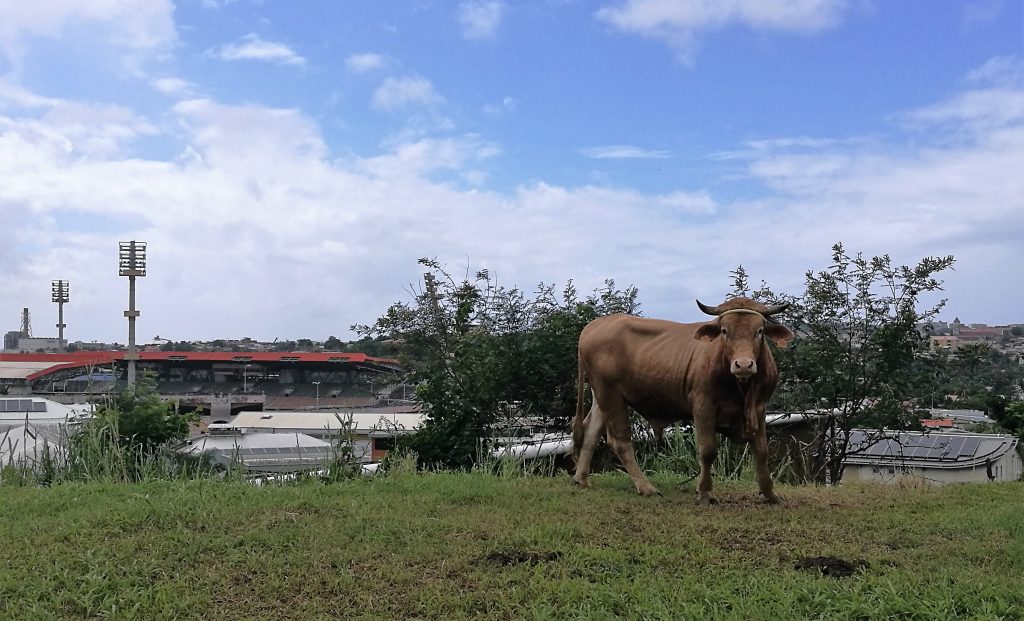
Stade Pierre-Aliker viewed earlier in the day before Martinique played Antiqua and Barbuda in 2018
Below this, League B was four groups of four, and League C was three groups of three, one of four. All groups were double round robin, with home and away games, (although some teams could not stage their own games, including Cuba in League A, using the Cayman Islands for their home games).
League A
The second iteration, two years later followed the same format, with the finals this time held at the stadium close to Las Vegas. The USA retained the title, beating Canada in the final, Mexico finished third with a win over Panama.
After this, there was a format change, with the League A increasing to 16 teams – but this was not to follow the obvious path of four groups of four. Instead, there are two groups of six with four teams exempt until a quarter final round. In the group stage, each team plays four games. This is arranged by splitting the teams into three seeding groups by their rankings.
In this system, a team will play one home and one away game against teams in other seeding group, but home and away against the team they are paired with in the same group. There are two teams in each group, so for a middle seeded team, there could be a home match against one higher seed, and an away match against the lower seeded team.
For the first occasion this system was used; USA, Mexico, Canada and Costa Rica had the exemption to quarter finals. In the two editions since then, Panama have been a top four team in place of Costa Rica.
Two teams from each group enter the quarter finals. In the first edition under this format, exempt teams Costa Rica and Canada lost to Panama and Jamaica respectively in the quarter finals (played as two legs). The finals were in the USA, and USA retained the title again
Two years ago, all four exempt teams made it through the quarter finals, played at the SoFi stadium. Panama then surprised USA in the semi-finals before losing to Mexico in the final.
This season, the qualified quarter-finalists are Curacao, Haiti, Guatemala and Jamaica, with the matches to be played in November.
League B
League B is also sixteen teams, but this is the more traditional format, four groups of four. In 2022-3, this was intended as home and away, although several games were switched to alternate venues. Two years later, it was decided that three of the four teams in each group would hold fixtures, with the September fixtures in one country, October in another and November in a third. For the 2026-7 competition, four matches were completed in this window, with two more in November. Two venues have been used in each group this month, with another for the November games. The group winners get promoted and will play in the next CONCACAF Gold Cup. The four red lantern teams get relegated. A new feature this season is that the four group winners will go forward into a knock out for the title of League B Champions.
League C
There are 41 teams in CONCACAF, so that leaves 9 in League C. These have been divided into three groups, with each team playing four matches – a double round robin.
In 2022, this was over three international windows, with home and away games as far as possible. Two years later, the schedule was reduced to be played in the September and October – with two host nations, one for September and one for October. Every team played twice in each series.
This time around, each group has a single venue for all games within its double round robin. Still, every team plays its four games within this lengthened international window. This is not ideal as it requires six fixture dates. The result is that for some teams, there is only one rest day between fixtures.
Four teams, (from the three groups) get promoted into League B for the next edition, while for the first time there will be semi-finals and a final.
Conclusions (Lack of…)
I don’t think any confederation can create a competition as complex as this. The Nations League also acts as qualification for the CONCACAF Gold Cup – the Gold Cup also running every second year (at the moment). CONCACAF therefore creates four champions every four years, with USA and Mexico taking the lion’s share. [All the Nations League titles to date, and all the Gold Cups, except 2000, when Canada won the prize). USA dominates hosting duties based on its economic muscle – giving out shares occasionally.
CONCACAF includes six nations that are not FIFA members. All would like to change their status. One of these is currently in League A of the Nations Leagues with four in League B. The results here show that there is no real reason for not bringing some or all of them into FIFA. The only thing that counts against them is that the countries concerned are all overseas territories of France or the Netherlands. The only reason a rule to prevent this exists is to prevent Gibraltar successfully applying for membership (and CAS ruled the change was made after Gibraltar has applied, so it did not count). This could be repealed without any damage to FIFA.
Despite the confusing formats, I guess this works. I am not convinced by the byes or the match format in League A, which appears unbalanced, and League C would be better in the three window format used in the past.